Psychological Study on Children's Art

As children begin to mature and go through different stages, their way of making art changes. In 1966, Herbert Read performed a study on children of various ages, comparing their drawings with their ages, and discovered many similarites between kids of similar ages, in the same stages of development. He discovered that around 14 months, children usually drew something like this...
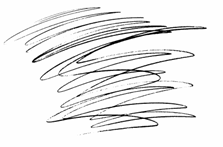
simple scribble
A drawing such as this...
is shapeless and purposeless
and requires little mouscle control
Around 18 months, a child would produce something more like this...
 
 A drawing like this...
shows the gradual change to including circular shapes within drawing
shows more control with arm movements

Around age 2, a child would produce something like this...
This drawing...
shows more use of arm, finger and wrist muscles
shows the building of knowledge from shapes seen
shows use of more demanding angles
Drawings such as these would continue to develop into more refined shapes, and eventually, children create more human-like forms like this...
Drawings continue to develop like this until they become more realistic, adding in more detail as they develop, with more accurate drawings.

Piaget's Theory of Development

I agree and disagree with some aspects of Piaget's theory on the stages of development. One aspect I do not agree with is the age of the preoperational stage of this development, in which the child can only think one dimensionally, which means they only can focus on one aspect, and that they still do not have the cognitive ability to think logically. Piaget states that this stage goes throughout the ages 2-7. I disagree with this age range due to the fact that a 5-7 year old may be a very logical thinkers at this age if they are slightly more advanced. For example, at the age of 6 I was already reading books such as Harry Potter and actually understanding them. Another aspect of it that i would slightly disagree with is the fact that in the formal operational stage, which is ages 12 and up, people just begin to thinking about abstract thinking and topics such as time, friends, love and faith. I feel that people start to understand concepts such as these at a much younger age. But, I agree with almost every other aspect of his theories as it seems accurate as to when people develop certain things such as object permanence and if a person is egocentric or not, as these are common things that are easy to evaluate and study.

Operant Conditioning


This video is a very clear example of Operant Conditioning. Penny is conditioned by Sheldon into behaving the way he wants her to through the chocolates. The chocolates Penny receives when she acts in a way favorable to Sheldon are positive reinforcement. This positive reinforcement causes her to want to repeat the action done to receive the reinforcement in the first place, therefore increasing the frequency of such behavior. Thus showing Operant Conditioning.